Handling pet insurance claims involves more than sending in a veterinary bill. Policy documents, medical records, itemized invoices, and insurer communications can all matter later, when you try to understand how a decision was made.
A Claim File, the organized set of those documents, lets you answer that question from your own records, building it from your first veterinary visit onward. Let’s break it down.
How Does a Pet Insurance Claim Work?
Most pet insurance claims follow a similar process: veterinary care, documentation, submission, insurer review, and a coverage decision. Each step shapes the next.
Along that path, three numbers can diverge. The veterinary bill, the eligible amount under your policy, and the final reimbursement aren’t necessarily the same, and the difference becomes clearer once you understand what happens at each step.
This guide walks through each stage, starting with how to prepare before you even file a claim.
Build Your Pet Insurance Claim File
A claim file is simply the pet insurance claim documentation that lets you reconstruct what was submitted and how it was evaluated. Keeping the documents together as treatment happens, rather than searching for them later, saves real time.
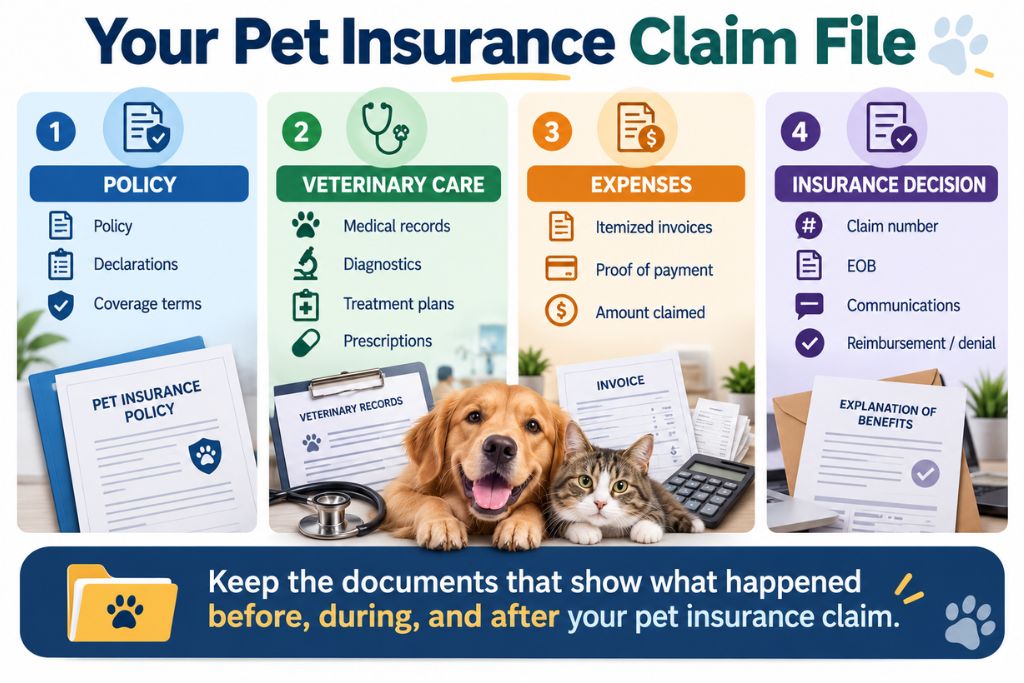
That file typically includes your policy and declarations page, the claim number or form, veterinary records, diagnostic reports, itemized invoices, proof of payment, treatment or prescription details, the EOB, insurer communications, and the final coverage decision.
Organizing these as you go means you’re never reconstructing a claim’s history from memory months later. It also makes it much easier to spot exactly where a decision and your records disagree, if that ever happens.
Keep Your Pet Insurance Claim Organized
Download our free Pet Insurance Claim & Dispute Checklist to keep your policy, veterinary records, expenses, claim details, and insurer communications in one place.
Download the Free Claim Checklist
Review Your Policy Before You File
For pet owners in Florida, understanding policy terms is an important step before submitting a claim. Coverage conditions can vary among pet insurance companies in Florida, and even similar policies may handle the same veterinary expenses differently.
Reviewing your deductible, reimbursement percentage, coverage limits, waiting periods, exclusions, and pre-existing condition provisions can help you understand what to expect when your claim is evaluated.
The key question before filing is simple: What does your policy say about how your claim will be evaluated?
Veterinary Records Can Shape How a Claim Is Reviewed
Complete, accurate pet insurance veterinary records tend to matter more than owners expect, especially once pet insurance claims move beyond routine, single-visit treatment. Clinical notes, symptoms, diagnosis, diagnostic results, treatment, prescriptions, referrals, and relevant prior history all factor into how an insurer reads a claim.
Dates matter just as much as the notes themselves. Symptoms recorded before a formal diagnosis can become relevant whenever a pre-existing condition question comes up, since insurers often look past the diagnosis date to what the record shows earlier.
File the Claim and Keep a Record of What You Submit
Keep a copy of exactly what you submitted, since you’ll compare that record against the insurer’s response. Write down the claim number, the date submitted, the amount claimed, the documents included, and any submission confirmation you received.
If you are wondering how to file a pet insurance claim, steps differ across pet insurance Florida policies, so follow your insurer’s claim form and instructions, and use your notes to record what you submitted.
How to Read Your Pet Insurance Claim Decision
A claim decision usually lists the amount submitted, the eligible amount, your deductible, the reimbursement percentage, coverage limits, excluded charges, the final reimbursement, and the insurer’s explanation. That explanation is the pet insurance Explanation of Benefits, or EOB, and reading it line by line tells you more than the total does.
Why is your pet insurance reimbursement lower than your veterinary bill? Often, the deductible and reimbursement percentage are doing what the policy says, and a lower number doesn’t automatically mean an incorrect underpayment.
How to Review a Pet Insurance Claim Decision
| Claim Information | What to Check |
|---|---|
| Amount submitted | Veterinary expenses included |
| Eligible amount | Expenses considered eligible |
| Deductible | Amount applied before reimbursement |
| Reimbursement rate | Percentage applied |
| Coverage limit | Whether a limit affected payment |
| Excluded amount | Expenses not considered eligible |
| Final reimbursement | Amount paid |
| Insurer explanation | Reason for reduction or denial |
Denied, Underpaid, Delayed, or Just Different Than Expected?
Denied means coverage was declined. An underpaid pet insurance claim means you believe the reimbursement should have been higher. Delayed or pending means the review has not concluded or the insurer is waiting on information.
Differences from expectations often trace back to the deductible, reimbursement rate, exclusions, or limits in your policy.
Identify which of these four situations applies before assuming a dispute exists, whether you are reading about a denied pet insurance claim or checking an underpayment.
What Should You Do If Something Doesn’t Add Up?
Start by saving the insurer’s explanation, then compare it with your policy and your claim file to identify the specific discrepancy. Focus on the exact part of the decision that does not appear to match your policy, records, or claim documentation.
Next, request clarification or a pet insurance claim review, and save every communication that follows, including dates and names from phone calls. If the answer still doesn’t fit and you are considering a pet insurance claim appeal, Florida pet insurance attorneys can explain how your policy’s terms apply.
Still Not Sure What the Insurance Company’s Decision Means?
If you’ve reviewed your policy, veterinary records, and claim decision but something still doesn’t add up, speak with a pet insurance attorney during a free 15-minute consultation.
What Veterinary Clinics Can Provide for a Pet Insurance Claim
Your veterinary clinic can provide the medical history, clinical notes, diagnostic results, referrals, treatment plans, prescriptions, and itemized invoices that support a claim. Ask for copies as treatment wraps up, so each record lands in your claim file and stays ready if a review comes later.
The clinic documents your pet’s medical care, and the insurer determines coverage under the policy.
When a Pet Insurance Claim May Need Legal Review
A persistent discrepancy between the policy language, veterinary records, claim documentation, and the insurer’s explanation can turn a routine review into a pet insurance claim dispute. Common examples include a disputed pre-existing condition, an unexplained denial, an unclear reimbursement calculation, or an exclusion that seems inconsistent with the policy.
When one of these appears, and your claim file doesn’t resolve it, pet insurance attorneys can review the documentation with you before you respond to the insurer.
Keep Your Claim File Ready
Keep your policy on hand, save your veterinary records, track exactly what you submitted, review the decision carefully, and identify specific discrepancies rather than general frustration. A well-organized claim file makes handling pet insurance claims faster and far less stressful.
Need Help Understanding a Pet Insurance Claim Decision?
Request a Free Claim Review