A vet or specialist recommends an MRI, and suddenly you’re looking at a bill that can run into four figures.
Does pet insurance cover MRI scans like this? Usually, yes, when the scan is a diagnostic expense for a covered accident or illness, but coverage doesn’t mean you get reimbursed for the full bill. CT scans and ultrasounds raise the same question, with the same answer. Let’s take a deeper look.
Does pet insurance cover MRI and other advanced diagnostic tests?
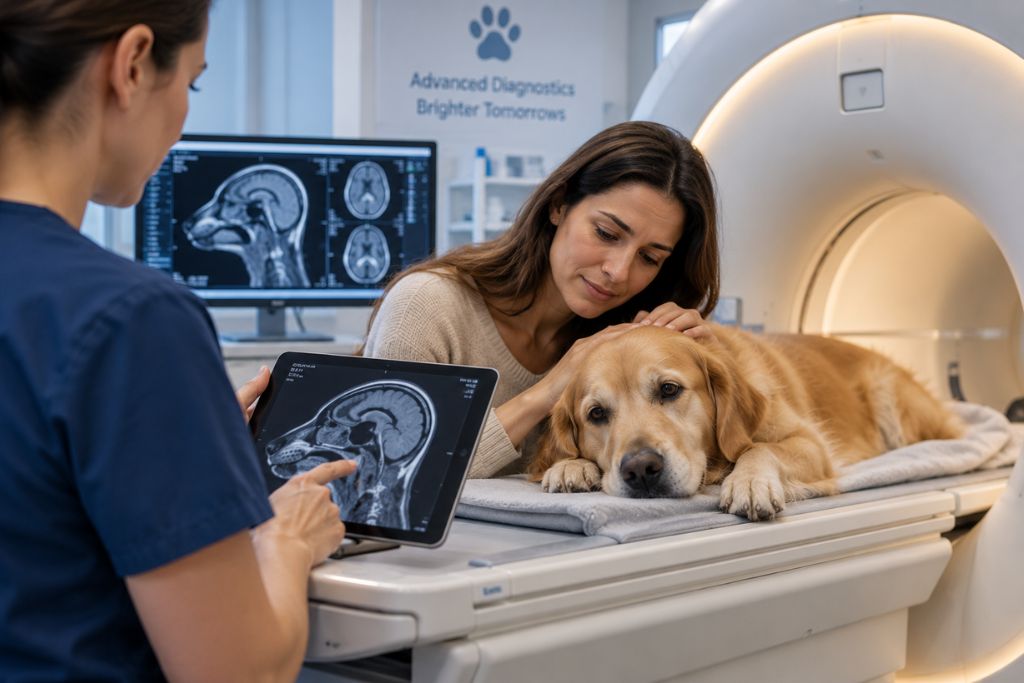
Does pet insurance cover MRI? In many cases, yes. Some Accident & Illness policies extend pet insurance MRI coverage alongside CT scans, ultrasounds, X-rays, and laboratory tests, provided a vet orders the test to investigate a covered condition.
Questions like “does pet insurance cover CT scans” or “does pet insurance cover ultrasound” come down to the same three factors every time: your policy, the specific condition being investigated, and any exclusions that apply to your pet.
Getting a yes on coverage is usually the easy part, though. The more important question after a claim is often not whether the MRI was covered, but how much of the diagnostic bill actually qualifies for reimbursement.
Why didn’t pet insurance cover 100% of my pet’s MRI?
An MRI can be fully eligible under your policy and still return a reimbursement well below the total bill; the difference comes from how the math works. Your total veterinary bill, the eligible expenses your insurer recognizes, and your final reimbursement are three different numbers, not one, which is where “does pet insurance cover MRI” gets complicated.
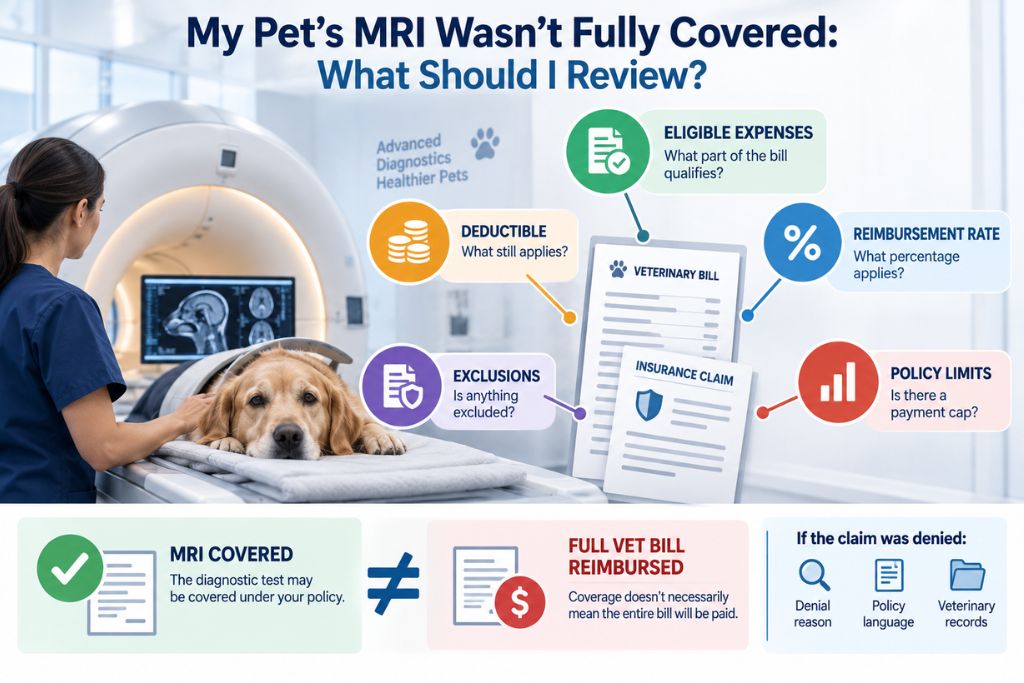
Your deductible, reimbursement percentage, and any applicable coinsurance can all affect the amount you receive. Policy limits, per condition or per year, can further cap the payout, and any non-eligible or excluded charges may not be included in the reimbursement calculation.
None of this means the claim was mishandled, just how the math works.
What parts of an MRI, CT scan or ultrasound bill may affect reimbursement?
A diagnostic bill like this rarely comes from one line item. It typically moves through several stages: a specialist consultation, preliminary tests to prepare for the scan, sedation or anesthesia to keep your pet still, the MRI or CT scan itself, the radiologist’s interpretation of the images, and sometimes a follow-up visit to discuss results.
Your insurer reviews each charge against your policy separately, not as one lump sum, so a bill can be partly eligible and partly excluded. Which specific charges qualify depends entirely on your policy’s terms, not on any fixed rule about what an MRI bill should include.
How is pet insurance reimbursement for an MRI calculated?
If your policy says 80% reimbursement, it’s natural to expect 80% of the total MRI bill back. That’s rarely how the calculation actually works.
The starting point is always your veterinary bill, the full amount charged for the visit. From there, the insurer narrows that number down to eligible expenses, since not every line item necessarily qualifies.
Your deductible comes out of that eligible amount next, and only then does your reimbursement percentage apply to what remains. Whatever limits your policy sets, per condition or per year, get checked last, producing the final number that lands in your account.
The exact order can vary by policy, but the sequence below shows roughly how most claims move through it.
Why Your MRI Reimbursement May Be Lower Than the Veterinary Bill
This is a hypothetical example. The actual calculation depends on your policy.
| Part of the Claim | Hypothetical Example | How It May Affect Payment |
|---|---|---|
| Total veterinary bill | $4,000 | Total charged by the veterinary provider. |
| Non-eligible charges | $300 | Some expenses may not qualify under the policy. |
| Eligible expenses | $3,700 | Amount considered before other policy terms. |
| Remaining deductible | $500 | May reduce the reimbursable amount. |
| Reimbursement rate | 80% | Applied according to the policy's terms. |
| Policy limits | Varies | May further affect the final reimbursement. |
An 80% reimbursement rate does not automatically mean receiving 80% of the original veterinary bill.
Why can an MRI or diagnostic claim be denied?
A pet insurance MRI claim can be denied for reasons unrelated to whether the scan itself was medically appropriate. An excluded condition is a common reason: the diagnosis investigated simply isn’t covered by the policy. A pre-existing condition raises a different question tied to your pet’s history rather than the test performed, and a waiting period can apply if the condition surfaced too soon after coverage started.
Unmet medical necessity requirements, non-eligible expenses, policy limits already reached, or disagreement over what the veterinary records show can each result in the same outcome: a denied pet insurance claim. An MRI can be eligible on its own while the condition it investigates raises a separate coverage issue, and that distinction drives many pet insurance claim disputes.
How to dispute a denied or underpaid MRI claim
Turning this into action starts with a short review of what you actually received:
- Review the EOB or denial letter to identify what was reduced or rejected, and why.
- Compare that decision against your policy’s diagnostic coverage, exclusions, deductible, reimbursement percentage, and limits.
- Review your veterinary records to confirm what justified the exam and which condition was investigated.
- Gather the itemized invoice along with any diagnostic documentation your vet can provide.
- Follow the insurer’s reconsideration or appeal process, if available.
- Keep the insurer’s written response on file if the disagreement continues.
None of this guarantees additional reimbursement, but it puts you in a position to request a free consultation if the numbers still don’t add up.
What Florida law means for an MRI coverage dispute
Florida Statute §627.71545, the state’s Pet Insurance Act, doesn’t require insurers to cover any specific test like an MRI or CT scan. It does require transparency about how insurers reach their numbers.
Under the statute, pet insurers must disclose the formula they use to calculate claim payments, including deductibles, coinsurance, and policy limits, and waiting periods are capped: none for accidents, up to 30 days for illness. When an insurer cites a pre-existing condition to deny or reduce a claim, Florida insurance law puts the burden of proving that exclusion on the insurer, not you.
When should a diagnostic claim be reviewed by a pet insurance attorney?
A closer review makes sense once the difference between what you expected and the insurer’s decision is hard to explain, especially when the denial reason doesn’t match your policy, a pre-existing condition is cited, a large part of the bill is ruled ineligible, or the reimbursement math is unclear.
Your Pet Attorneys reviews the policy alongside the EOB or denial, the veterinary records, the itemized bill, and the insurer’s explanation; the same documents pet owners across Florida bring when a diagnostic claim doesn’t add up.
Key takeaways about pet insurance MRI coverage
- Does pet insurance cover MRI? Often yes, along with CT scans and ultrasounds, when they qualify under your policy.
- A covered MRI does not necessarily mean your entire veterinary bill will be reimbursed.
- Your deductible, reimbursement rate, limits, and exclusions can all affect your final payment.
- The condition being investigated can affect coverage even when the diagnostic procedure itself is eligible.
- If your claim is denied or underpaid, compare your policy terms, veterinary records, and the insurer’s explanation.
Was your pet’s MRI, CT scan or ultrasound claim denied or underpaid?
If your pet already had an MRI, CT scan, or ultrasound and the claim came back denied or underpaid, Your Pet Attorneys can step in. We review the policy, the itemized bill, the veterinary records, and the insurer’s explanation together to see how they reached that decision and whether the numbers match what your policy actually promises.
Request a Free Claim Review