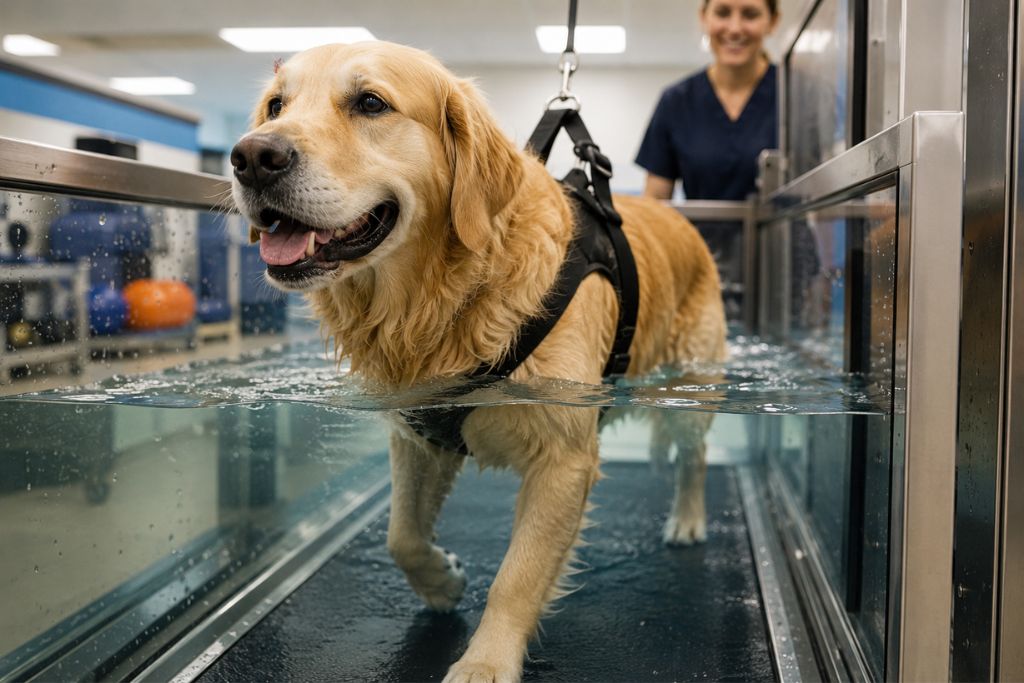
Surgery is rarely the final step in your pet’s recovery. Afterward, your veterinarian may recommend a pet rehabilitation program to rebuild strength, improve mobility, and manage pain.
These sessions are part of the treatment itself, which means they can also become part of your insurance claim, raising real questions about your pet coverage and how much comes back to you. This guide follows that journey, from surgery to the point where rehabilitation meets your policy’s terms.
Why recovery often continues beyond surgery
Surgery repairs the immediate problem, but your pet’s body still needs to relearn how to move correctly afterward. This is why pet rehabilitation after surgery has become necessary, especially involving joints, bones, or the nervous system.
Picture a dog recovering from a torn cruciate ligament repair: the joint may heal on schedule, yet the surrounding muscle can waste away from weeks of reduced use if nothing addresses it directly. A hip repair or a fracture stabilized with plates and screws follows a similar pattern.
Neurological conditions also bring a different challenge. A pet recovering from a spinal injury often needs help retraining muscle memory and coordination, something medication alone cannot accomplish.
Surgery addresses the injury itself, while regaining full function and comfort unfolds separately, at a pace your veterinarian tailors to your pet’s age, breed, and procedure. Not every pet follows the same timeline, even after similar procedures.
How pet rehabilitation becomes part of the recovery plan
Once your veterinarian clears your pet for rehabilitation, the recovery plan usually blends several techniques rather than relying on just one, all aimed at restoring function safely without undoing the surgical repair.
Therapeutic exercises form the foundation, guiding your pet through controlled movements that gradually rebuild strength. Pet physical therapy sessions often include stretching, balance work, and targeted strengthening for the affected area.
Hydrotherapy for dogs is another common piece, particularly for larger breeds or joint-heavy recoveries. Water’s buoyancy lowers the load on healing joints, letting your pet build stamina without the strain of walking on solid ground.
A cat recovering from a fracture repair might instead start with gentle range-of-motion work, then move into hydrotherapy once the incision has fully closed. Pain management runs alongside it all, adjusted as mobility improves.
Your veterinary team coordinates them into a single plan, and each session gets logged as part of your pet’s treatment.
When pet rehabilitation becomes part of an insurance claim
It happens the moment your vet documents it as part of the treatment plan tied to the original surgery. From there, each session spawns clinical documentation your policy issuer can request when reviewing eligible expenses.
Pet insurance rehabilitation coverage is not automatic in every policy, and it rarely works the same way across providers. Some bundle rehabilitation costs into the original surgical claim, while others require a separate submission for each stage.
Florida’s pet insurers vary in how they draw that line, so it matters to read your policy’s definition of eligible treatment before sessions begin.
The review process checks whether a licensed veterinarian recommended pet rehabilitation after surgery, whether it connects to a covered condition, and whether the number of sessions falls within what your policy considers reasonable.
A dog needing eight weeks of therapy after hip surgery, for instance, generates a claim history tying each invoice back to the original procedure, exactly what a reviewer looks for.
In the end, rehabilitation reimbursement ultimately comes down to your policy’s specific terms. Two pet owners with nearly identical surgeries can see very different outcomes simply because their policies define eligible coverage differently.
Why rehabilitation claims sometimes raise coverage questions
A question about your reimbursement does not automatically signal a problem with your claim. Rehabilitation involves ongoing care, which naturally invites more scrutiny than a single procedure with a clear start and end date. Partial reimbursement usually traces back to a few recurring issues.
Many policies cap the number of covered sessions per condition or per year, so a treatment plan that runs longer than expected can hit that ceiling before recovery is complete. Additional sessions beyond the original plan sometimes require new documentation before the insurer approves further reimbursement.
A rehabilitation program not clearly tied, in writing, to the original diagnosis can leave a reviewer uncertain about which portion of the treatment counts as eligible, since a thin file leaves more room for interpretation. These situations sit at the center of many pet insurance claims, usually tracing back to a skipped documentation step.
Interpretation plays a role too: your veterinarian may view twelve weeks of therapy as medically necessary, while the insurer’s guidelines suggest a shorter standard course, a difference in judgment that shows up more often in rehabilitation claims than in most other treatment types.
A claim typically turns into a real dispute only when a written explanation fails to resolve that kind of disagreement.
What to do if your rehabilitation claim is questioned
These steps can help you respond with the right information from the start:
- Review your policy to confirm exactly how it defines eligible rehabilitation sessions and any limits.
- Keep all veterinary documentation, including session notes and the original treatment plan.
- Ask the insurer for a written explanation of which expenses were reduced or excluded.
- Loop in your veterinarian, who can clarify the medical reasoning behind the therapy recommended.
- Compare that explanation against your policy’s actual language before accepting the outcome.
- If real doubts remain about how the decision was reached, you can Contact Your Pet Attorneys for a legal review.
How Your Pet Attorneys can help
Rehabilitation claims involve more than a single surgical bill, which is exactly where questions tend to surface. Our team reviews these cases when coverage decisions, policy interpretation, or reimbursement calculations don’t match what the treatment plan and documentation support.
We look at the same records your insurer used, then identify where the reasoning breaks down. Most of these situations come down to paperwork that doesn’t tell the full story, and our job is to fill in what is missing so you get the reimbursement your policy actually promises.
Questions About Your Rehabilitation Claim?
Our attorneys can review your policy, veterinary records, and claim decision to help you better understand your options.
Veterinary Recovery and Insurance Claim Process
| Veterinary Recovery and Insurance Claim Process | What Happens | Insurance Consideration |
|---|---|---|
| Diagnosis | The veterinarian identifies the condition | Medical records begin the claim history |
| Surgery | Treatment is performed | Eligible expenses depend on the policy |
| Rehabilitation | Recovery plan continues | Additional treatments may require documentation |
| Claim Review | The insurer evaluates the claim | Coverage and reimbursement are determined |
| Reimbursement | Payment is issued | Questions may emerge if expenses are only partially covered |
From surgery to recovery: when rehabilitation becomes part of an insurance claim
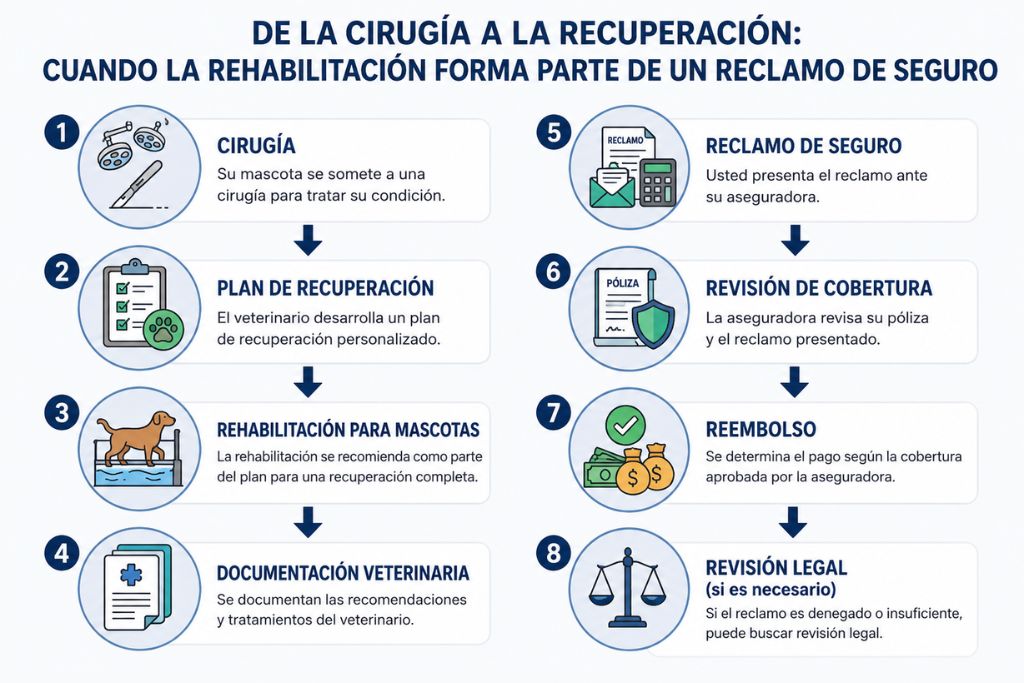
Recovery May Continue After Surgery, and So Can Your Insurance Claim
If you have questions about rehabilitation coverage or reimbursement, Your Pet Attorneys can review your policy, evaluate your claim, and help you understand your legal options.