Most pet owners don’t discover how loosely coverage companies define what counts as a trupanion pre-existing condition until they’re already in the middle of a dispute. Understanding exactly how Trupanion handles these situations, and what Florida law says about them can put you in a much stronger position both before and after a denial.
Florida’s HB 655 Law, which introduced the Pet Insurance Act under Florida Statute § 627.71545, brought meaningful protections for pet owners facing these challenges. Knowing how a trupanion pre-existing condition may be interpreted, and when that interpretation can be challenged is where the real conversation begins.
How Trupanion Defines a Pre-Existing Condition
The company considers any illness, injury, or symptom that appeared before the policy’s start date, or during the waiting period. That means signs or symptoms in your pet’s medical record can be enough for them to apply the exclusion. From here:
- Any documented visit, treatment, or recommendation made before your coverage began can become grounds for denial
- A limp noted at a routine checkup, or mild digestive issues on a past record, can be treated as evidence of a pre-existing condition
- The connection between a past record and your current claim is drawn by the company, often without additional input from your vet.
- Conditions that are considered curable may be revisited after a symptom-free period, but chronic or recurring issues typically remain permanently excluded
A symptom noted years ago can reappear as a justification for denying something that looks, to you, like an entirely new problem.
What Does the Florida Pet Insurance Act Require?
Florida’s HB 655 Florida Law, codified under § 627.71545, created a set of binding obligations for every coverage company selling animal insurance in the state:
- Pet insurers must use the statutory definitions, include them in the policy itself, and make them available through a clear and conspicuous link on the main page of its website
- They must disclose whether the policy excludes coverage due to pre-existing conditions, chronic conditions, congenital anomalies or disorders, or hereditary disorders before the policy is purchased
- Waiting periods and applicable requirements must be clearly and prominently disclosed to applicants before the purchase
- They must create a summary of all required policy disclosures in a separate document titled “Insurer Disclosure of Important Policy Provisions”
So, a denial based on a pre-existing condition that was never properly disclosed at the time of enrollment is a denial that may not hold up under Florida law.
What Trupanion Typically Covers vs. What It Doesn’t
| Covered | Not Covered |
|---|---|
| New illnesses | Pre-existing conditions |
| Accidents | Symptoms documented before enrollment |
| Surgeries for covered conditions | Chronic untreated issues |
| Diagnostics tied to covered conditions | Conditions related to prior recorded symptoms |
The line between “new illness” and “related prior condition” is where most disputes begin. A pet owner sees a new, independent problem; the company sees a continuation of something that was already in the records.
Most Common Issues with Trupanion Pre-Existing Condition Claims
- “Related condition” arguments: Trupanion may link a current illness to a past record entry even when your vet never characterized them as related
- Minor, passing symptoms used as anchors: a single mention of mild symptoms in an annual exam can resurface as justification for denying a more serious claim filed years later
- Records are sometimes interpreted out of context, with isolated notes treated as evidence of an established condition when no diagnosis was ever made.
- Broad language around chronic conditions can sweep in issues that are newly diagnosed
Why Claims Are Denied: Real Patterns
- Medical history reinterpretation: company reviews your pet’s full veterinary history and draws a connection between a past entry and the current claim
- Timeline disputes: symptoms existed before the policy effective date, even when the onset is genuinely ambiguous or the records don’t establish a clear timeline.
- Linking unrelated conditions: two conditions that share a general body system get treated as the same condition for purposes of the exclusion
- Documentation gaps: missing records, unsigned forms, or incomplete invoices
How to Respond to a Denied Trupanion Claim
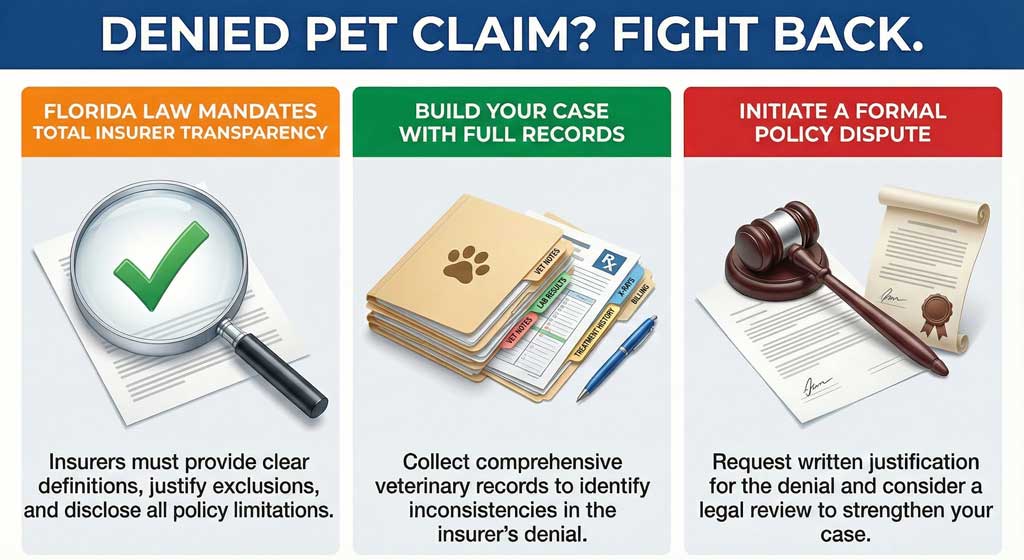
- Look at the exact exclusion cited and whether the definition used matches the statutory definition required by Florida law
- Request written justification from Trupanion that specifies which policy provision applies
- Collect your pet’s complete veterinary records
- Identify inconsistencies between what the records actually say and how the company characterized them
- Consider a formal dispute if the denial involves a condition your vet does not consider related to any prior issue
Real Case Scenarios
Case 1
A dog had mild allergy symptoms noted at a routine exam before the owner enrolled in Trupanion coverage. Later, the dog developed a more serious skin condition and the claim was denied, with the company pointing to that early exam note as evidence of a pre-existing condition.
Solution: The medical records, reviewed in context, did not support the company’s link. The denial was challenged and the claim was ultimately approved.
Case 2
A dog showed minor urinary discomfort before enrollment, but no diagnosis was made and no treatment was prescribed. After the policy began, the dog was diagnosed with a urinary tract infection, and it was marked as pre-existing.
Solution: With full veterinary documentation and legal support, it was demonstrated that the earlier symptom had no clinical connection to the diagnosed infection
A denied claim is not always the final decision. Many cases depend on how medical history is interpreted—and that interpretation can be challenged with the right evidence and legal strategy.
Your Legal Rights as a Pet Owner in Florida
Under the Pet Insurance Act, the rules governing how policies are sold and how exclusions are applied are enforceable:
- Right to clear policy language
- Right to pre-sale transparency
- Right to dispute claim decisions
- Protection against misleading practices
These rights are active as long as your legal options remain open.
When to Seek Legal Help
- The rejection was based on unclear reasoning, a vague “related condition” argument, or a connection your vet wouldn’t make
- You received a partial payment with no explanation of why full coverage wasn’t applied
- They classified your pet’s condition as pre-existing despite no formal diagnosis ever having been made before your policy started
Coverage lawyers in Florida who work specifically with pet insurance cases can identify whether it’s the kind of overreach the Pet Insurance Act was designed to address.
The Bottom Line
If Trupanion denied your claim and the reasoning doesn’t match what your vet has said, get a free claim review with Your Pet Attorneys and find out whether your case can be challenged before you absorb a bill you may not have to pay.